

Reviewed by: Scot C. Holman, MD, Santa Fe Surgery Center, Board-Certified Laser Cataract & Lens Replacement Surgeon.
The Light Adjustable Lens may suit patients who value the ability to customize their vision after cataract surgery through postoperative adjustments. Multifocal lenses may suit patients who want a lens designed to provide multiple focus ranges, including near, intermediate, and distance vision.
Table of Contents
Understanding the Difference Between The Light Adjustable Lens and Multifocal Lenses
Choosing the right lens implant after cataract surgery can feel overwhelming. Many patients know cataract surgery can help restore clearer vision, but they may not realize that selecting an intraocular lens (IOL) is an important part of the process.
Questions like “Will I still need glasses?” or “Which premium lens option fits my lifestyle?” are common during cataract consultations. Today, patients have access to several Premium IOL options for cataract surgery, including the Light Adjustable Lens and multifocal lenses. Each option works differently and may be suitable for different visual goals.
Understanding the difference between the light adjustable lens vs. a multifocal option can help patients have a more informed conversation with their ophthalmologist. The best choice depends on factors such as eye health, lifestyle needs, visual expectations, and overall candidacy.
Understanding IOLs in Cataract Surgery
A cataract develops when the eye’s natural lens becomes cloudy, which may cause blurry vision, glare, difficulty seeing at night, or changes in color perception. During cataract surgery, the cloudy natural lens is removed and replaced with an artificial intraocular lens (IOL).
An IOL becomes the eye’s new focusing lens after cataract surgery. Different IOL technologies are designed to address different vision goals. The Light Adjustable Lens and multifocal lenses are two premium IOL options that use different approaches to help patients achieve their postoperative vision goals.
The American Academy of Ophthalmology recommends that patients discuss the benefits, limitations, and expectations of different IOL choices with their ophthalmologist before surgery.
Patients considering cataract eye surgery can learn more about available treatment options through a personalized consultation with an experienced cataract specialist.
Learn more about Lake Eye Associates’ cataract services: cataract eye surgery
What is the Light Adjustable Lens?
The Light Adjustable Lens is a type of premium intraocular lens designed to allow doctors to make adjustments after cataract surgery.
Unlike traditional lenses, where the lens power is determined before implantation, the Light Adjustable Lens can be adjusted after the eye begins healing. The lens contains a photosensitive material that responds to controlled ultraviolet (UV) light treatments performed in an office setting.
The U.S. Food and Drug Administration (FDA) approved the Light Adjustable Lens and Light Delivery Device system in 2017. The system allows physicians to make certain lens power adjustments after surgery for eligible patients.
How Does Light Adjustable Lens Cataract Surgery Work?
The process generally includes:
1. Cataract removal and lens implantation
The cloudy natural lens is removed and replaced with the Light Adjustable Lens.
2. Healing period
The eye is allowed time to heal after surgery.
3. Vision assessment
The ophthalmologist evaluates the patient’s vision and prescription.
4. Light adjustments
Customized UV light treatments are performed using the Light Delivery Device to fine-tune the lens.
5. Lens lock-in process
Additional treatment helps stabilize the final lens adjustment.
Patients must follow postoperative instructions carefully, including wearing special UV-protective glasses during the adjustment period.
Quick Fact:
The Light Adjustable Lens is currently the only FDA-approved IOL designed to be adjusted after cataract surgery using UV light treatments.
What Are Multifocal Lenses?
Multifocal lenses are premium IOLs designed to provide vision at multiple distances by distributing incoming light to different focal points.
These lenses may help some patients reduce dependence on glasses for activities such as reading, computer work, and distance viewing. Multifocal IOLs are part of a broader category of presbyopia-correcting lenses designed to address age-related changes in near vision.
How Do Multifocal Lenses Work?
Multifocal lenses use specialized optical designs to create multiple focus points. Depending on the lens design, patients may receive improved vision at:
- Near distances
- Intermediate distances
- Far distances
However, the way each patient adapts can vary. Lifestyle needs, eye health, and personal expectations are important considerations when discussing multifocal lenses with a cataract specialist.
Light Adjustable Lens vs. Multifocal: Key Differences
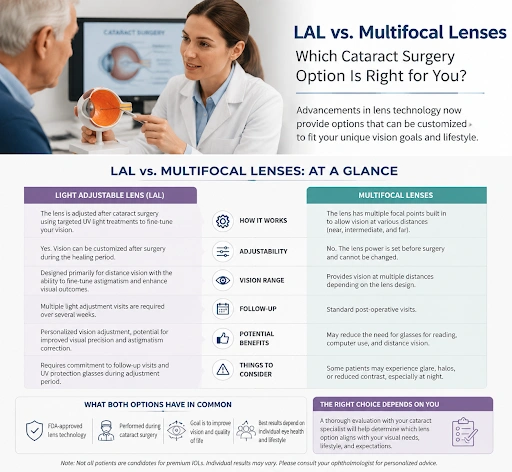
| Feature | Light Adjustable Lens | Multifocal Lens |
| Adjustment after surgery | Yes, through scheduled light treatments for eligible patients | No, lens power is selected before implantation |
| Main approach | Customized postoperative adjustment | Multiple-focus optical design |
| Vision goals | Fine-tuning prescription after healing | Improving vision across different distances |
| Considerations | Requires follow-up visits and UV protection compliance | Some patients may notice glare or halos |
| Best discussed with | Cataract specialist after complete eye evaluation | Cataract specialist after complete eye evaluation |
Both options require careful patient selection. There is no single lens choice that is ideal for every person.
How to Choose Between the Light Adjustable Lens and Multifocal Lenses:
Choosing a premium intraocular lens is not only about the technology. It is about how you use your vision every day.
During a cataract consultation, your ophthalmologist will consider your eye health, visual expectations, and activities that matter most to you.
If You Value Customized Vision After Surgery
The Light Adjustable Lens may be considered by patients who prefer a more adjustable approach.
Example patient profile:
“I spend a lot of time working on detailed projects, driving, and using digital devices. I want my surgeon to have the ability to fine-tune my vision after my eye heals.”
For eligible patients, the Light Adjustable Lens technology allows doctors to adjust the lens power after surgery using specialized light treatments.
Patients considering the Light Adjustable Lens should also understand that it requires additional follow-up visits and wearing UV-protective glasses during the adjustment period.
If You Want Vision at Multiple Distances
Multifocal lenses may appeal to patients who want an IOL designed with multiple focus points.
Example patient profile:
“I enjoy reading, traveling, and staying active. Reducing my dependence on glasses for different activities is important to me.”
Multifocal lenses are designed to provide vision across different distances. However, some patients may notice visual effects such as glare or halos, especially in low-light conditions.
| Your Vision Priority | Lens Option to Discuss With Your Cataract Specialist |
| I want the ability to fine-tune my vision after surgery | Light Adjustable Lens may be an option for eligible patients |
| I want to see at multiple distances without relying on glasses as much | Multifocal lenses may be considered |
| I frequently drive at night | Discuss how each option may affect night vision quality, including glare and halos |
| I spend many hours reading or using computers | Discuss intermediate and near vision goals |
| I have other eye conditions | Your ophthalmologist will evaluate whether premium lenses are appropriate |
Factors Your Cataract Specialist Considers When Comparing the Light Adjustable Lens and Multifocal Lenses

When comparing the Light Adjustable Lens and multifocal lenses, your cataract specialist looks beyond the technology itself. The goal is to determine how each option may align with your eye health, everyday visual needs, and expectations after cataract surgery.
1. Your Daily Activities
Your lifestyle plays an important role in determining your visual priorities and which of the two lens approaches may be appropriate to discuss.
Examples include:
- Reading frequently
- Driving at night
- Working on digital devices
- Playing sports or outdoor activities
- Performing detailed hobbies
2. Your Overall Eye Health
Certain eye conditions may influence whether the light adjustable lens, a multifocal lens, or another lens option is appropriate.
Your ophthalmologist may evaluate:
- Corneal health
- Retina health
- Glaucoma status
- Existing astigmatism
- Macular health
3. Your Vision Expectations
Patients should discuss realistic expectations before surgery. Some people may value the postoperative customization offered by the Light Adjustable Lens, while others may prioritize the multiple-distance design of a multifocal lens.
Your ophthalmologist can explain how each option relates to your specific vision goals and whether either lens is suitable for your eyes.
Pro Tip:
Bring a list of your most important daily vision activities to your cataract consultation. Understanding how you use your vision can help your ophthalmologist discuss whether Light Adjustable Lens, a multifocal lens, or another option may better align with your needs.
Who May Be a Candidate for the Light Adjustable Lens or Multifocal Lenses?
The Light Adjustable Lens and multifocal lenses may be considered for patients who:
- Have cataracts affecting their vision
- Want to explore premium lens options during cataract surgery
- Have realistic expectations about surgical outcomes
- Are interested in reducing dependence on glasses
- Have eye health that is compatible with the specific lens technology being considered
However, candidacy for the Light Adjustable Lens vs. multifocal lenses is not identical. Each technology has its own clinical considerations, and a complete eye examination is necessary before determining whether either option may be appropriate.
For example, the Light Adjustable Lens is for adults with certain levels of pre-existing corneal astigmatism and without pre-existing macular disease.
A consultation with a cataract specialist is the best way to determine how your eye health, lifestyle, and vision goals relate to these two lens choices.
The Role of Laser Cataract Surgery in Modern Eye Care
Technology has continued to advance cataract procedures, providing surgeons with additional tools for planning and performing surgery.
Laser cataract surgery may involve the use of laser technology to assist with specific steps of the procedure. The overall surgical approach, lens selection, and technology used are customized based on each patient’s needs.
A comprehensive evaluation allows your eye care team to recommend the appropriate treatment plan.
Questions to Ask When Comparing the Light Adjustable Lens and Multifocal Lenses
Before deciding between these lens options, consider asking:
- Am I a candidate for the Light Adjustable Lens, a multifocal lens, or both?
- How does each lens option fit my most important daily vision needs?
- What vision range can I realistically expect with each option?
- How may each lens affect night driving or low-light vision?
- What additional visits or postoperative steps are required with The Light Adjustable Lens?
- What visual effects, such as glare or halos, may occur with multifocal lenses?
- How might my existing eye health affect which option is appropriate?
- Will I still need glasses for some activities with either lens?
- What are the potential benefits and limitations of each option for my individual eyes?
Did You Know?
Cataract surgery is one of the most commonly performed surgical procedures worldwide. Advances in intraocular lens technology have expanded patient choices beyond traditional single-focus lenses.
Key Takeaways
- The choice between the Light Adjustable Lens and a multifocal lens depends on individual vision goals and eye health.
- The light adjustable lens vs multifocal decision should be made after a detailed consultation with a cataract specialist.
- The Light Adjustable Lens allows postoperative lens adjustments for eligible patients.
- Multifocal lenses use advanced optics to provide multiple focusing points.
- Premium IOL options require realistic expectations and careful patient selection.
- Modern cataract eye surgery options are designed around personalized vision needs.
Conclusion
Choosing an intraocular lens is an important part of the cataract surgery journey. Both the Light Adjustable Lens and multifocal lens options represent advancements in cataract care, but they work differently and may serve different patient needs.
The right choice depends on your eye health, lifestyle, and vision priorities. A consultation with an experienced ophthalmologist can help you understand your options and determine which approach may be appropriate for your individual situation.
If you are considering cataract surgery, Lake Eye Associates can help you explore available lens options and develop a personalized treatment plan. Schedule an appointment!
Medical Disclaimer: The information provided in this blog is for general informational purposes only and may not be suitable for your specific insurance plan and cataract needs. It is important to consult a qualified healthcare professional for personalized advice and treatment.
Frequently Asked Questions
1. What is The RxSight Light Adjustable Lens?
The RxSight Light Adjustable Lens is designed to allow postoperative lens power adjustments using controlled UV light treatments after cataract surgery for eligible patients.
2. Can the Light Adjustable Lens replace the need for reading glasses completely?
The Light Adjustable Lens may help some eligible patients achieve their desired vision goals, but results vary from person to person. Your ophthalmologist can discuss what level of glasses independence may be realistic based on your eyes and lifestyle.
3. Are premium lenses covered by insurance during cataract surgery?
Insurance coverage varies depending on your plan and the type of lens selected. Some premium lens upgrades may involve additional costs. Your eye care team can review available options during your consultation.
4. How long does it take to decide on an intraocular lens before cataract surgery?
The timeline varies depending on your evaluation, eye measurements, and discussions with your surgeon. Many patients make their decision after reviewing their lifestyle goals and lens options during their cataract consultation.
5. Can someone with previous LASIK surgery receive a premium IOL?
Some patients with previous refractive surgery may still be candidates for certain IOL options. A detailed evaluation is needed because previous procedures can affect lens calculations and surgical planning.


