

Reviewed by: Jose Alfredo Vazquez, MD, Board-Certified Comprehensive Ophthalmologist
Table of Contents
Summary
You use your prescribed eye drops, keep your follow-up appointments, and do your best to protect your vision. But what happens to your eye pressure during the six, seven, or eight hours you spend in bed?
Questions about glaucoma and sleep position are understandable, especially when eye pressure appears controlled during daytime appointments, but glaucoma tests continue to show changes. Research suggests that lying flat, sleeping with one eye against a pillow, and certain side-sleeping positions may temporarily raise intraocular pressure, or IOP.
That does not mean your preferred sleeping position caused your glaucoma. It also does not mean everyone with glaucoma must sleep on their back. Sleep position is only one of many factors that may influence eye pressure. The most appropriate advice depends on your glaucoma type, the condition of each eye, your overall health, and the quality of your sleep.
This article explains what current research tells us, what remains uncertain, and when to discuss your nighttime habits with experienced glaucoma specialists.
Why Can Eye Pressure Change While You Sleep?
Intraocular pressure is the pressure created by fluid inside the eye. The eye continually produces a clear fluid called aqueous humor (this fluid is not the same as tears). This fluid nourishes structures in the front of the eye before leaving through its natural drainage pathways.
When the fluid does not drain as efficiently as it should, pressure may rise. Elevated IOP can place stress on the optic nerve and is one of the most important risk factors for glaucoma. However, pressure is not the entire story. Some people have high eye pressure without developing glaucoma, while others experience optic nerve damage even when their pressure readings are within a commonly accepted range.
Eye pressure also changes throughout the day. Posture, medication timing, physical activity, fluid intake, and natural daily rhythms may all affect an individual measurement. Moving from sitting or standing to lying down changes blood and fluid distribution around the head and eyes, which can contribute to higher nighttime IOP.
Quick Fact: About 3 million people in the United States have glaucoma, and approximately half may not know they have it. Open-angle glaucoma often develops without noticeable early symptoms, making regular eye examinations important.
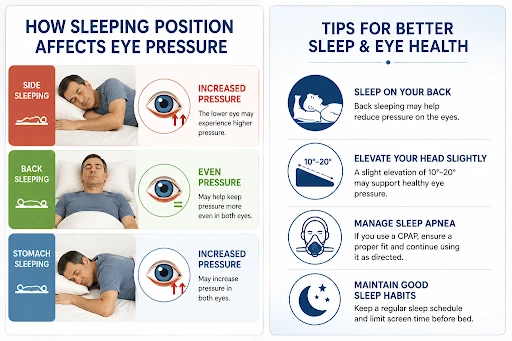
How Different Sleep Positions May Affect Eye Pressure
Several common sleeping positions can affect eye pressure in different ways. These findings offer helpful guidance, but they do not identify one ideal sleeping position for every patient.
| Sleeping position | What research suggests | What patients should consider |
| Flat on the back | IOP commonly rises after moving from an upright position to lying flat. | Back sleeping avoids direct pressure on either eye, but lying completely flat may still increase nighttime pressure. |
| Sleeping on one side | The eye closest to the mattress may experience a greater pressure increase. | Ask your doctor whether side preference matters when one eye has more advanced glaucoma. |
| Sleeping face-down | A prone position may raise IOP, particularly when the face or eye presses into bedding. | Avoid placing the eye directly against a pillow, mattress, hand, or arm. |
| Upper body gently elevated | Some studies found lower nighttime IOP compared with lying completely flat. | Use gradual support for the upper torso instead of sharply bending the neck. |
| Head raised with several tall pillows | Newer research suggests that neck flexion and compression may interfere with venous drainage and increase IOP. | More pillows are not necessarily better. Keep the head and neck comfortably aligned. |
Sleeping on Your Back
Sleeping on your back can help prevent direct pressure from being placed on either eye. However, a flat position may still produce higher IOP than sitting or standing.
This does not make sleeping unsafe. It simply shows that body position influences pressure. Your doctor will consider this information alongside your daytime readings, optic nerve images, visual field results, corneal measurements, and treatment history.
Sleeping on Your Side
Many people naturally sleep on their side because it feels comfortable or helps with snoring, joint discomfort, or back pain. Side sleeping is not automatically harmful for someone with glaucoma.
The dependent eye, meaning the eye closest to the mattress, may experience a higher IOP than the upper eye. There is also interest in whether patients with unequal glaucoma damage are more likely to sleep with the more affected eye facing downward. However, the available evidence is not consistent enough to show that side sleeping causes or accelerates glaucoma in every patient.
Patients with significantly more damage in one eye may still benefit from discussing their preferred side with their ophthalmologist. The doctor may recommend avoiding prolonged pressure on the more vulnerable eye, depending on the individual situation.
Sleeping on Your Stomach
Sleeping face-down deserves additional attention because the eye may come into direct contact with a pillow or mattress. Research simulating an eye pressed into a pillow found clinically meaningful temporary pressure increases. The American Academy of Ophthalmology advises people with glaucoma to avoid sleeping with an eye pressed against a pillow or arm.
The concern is not simply that the person is lying on their stomach. The greater issue is external pressure against the eye itself.
Can Sleep Position Cause Glaucoma?
Current evidence does not show that sleeping on your back, side, or stomach independently causes glaucoma.
Glaucoma is a group of conditions that damage the optic nerve. Its development may involve eye pressure, age, family history, eye anatomy, blood flow, corneal characteristics, medication use, previous eye injuries, and other health factors. Some people develop normal-tension glaucoma even though their measured IOP is not unusually high.
A sleeping position may contribute to temporary IOP elevations or pressure differences between the eyes. Researchers are still studying whether repeated nighttime changes affect long-term glaucoma progression.
The most accurate answer to “Can sleep position cause glaucoma?” is therefore no, not based on current evidence. Sleep position may be a relevant consideration for certain people who already have glaucoma, but it should not be viewed as a single cause or as a substitute for established treatment.
Could Elevating Your Head Lower Nighttime Eye Pressure?
Recent findings suggest that raising the head with multiple pillows may not lower eye pressure and could have the opposite effect. In a 2026 analysis of 144 patients with glaucoma, participants were evaluated while lying flat and while using two pillows that raised the head by approximately 20 to 35 degrees. Eye pressure increased in 66.7% of participants in the high-pillow position, with an average increase of 1.61 mmHg. The high-pillow position was also associated with greater 24-hour pressure fluctuation and lower ocular perfusion pressure.
This suggested that bending the neck over stacked pillows may compress the jugular veins and interfere with normal fluid and blood drainage around the eyes. These findings do not prove that every elevated sleeping position is harmful, and they should not be applied to wedge pillows or adjustable beds without further evidence. Patients with glaucoma should avoid sharply flexing the neck and ask their eye doctor before changing their sleeping setup specifically to manage IOP.
A Wedge Is Different From Stacking Pillows
A gradual wedge or adjustable bed raises the upper torso along with the head. Several tall pillows may instead push the chin toward the chest and sharply bend the neck.
A more recent study found that a high-pillow position was associated with higher IOP and lower ocular perfusion pressure in patients with glaucoma and ocular hypertension. Researchers suggested that neck flexion and jugular vein compression may have contributed to the change. This helps explain why simply adding more pillows is not always beneficial.
What Is the Connection Between Sleep Apnea and Glaucoma?
The relationship between sleep apnea and glaucoma involves more than sleep posture. Obstructive sleep apnea causes breathing to repeatedly decrease or stop during sleep. These episodes may reduce oxygen levels and affect blood flow.
A large 2026 cohort analysis of more than 12.5 million adults found that people with obstructive sleep apnea had a higher rate of newly diagnosed glaucoma than sleep-tested adults without OSA. After researchers adjusted for baseline health and demographic factors, patients with OSA who had no positive airway pressure device record had a 27% higher risk of developing glaucoma. The findings show an association rather than proof that sleep apnea directly causes glaucoma. They support regular eye examinations and coordinated care for patients undergoing evaluation or treatment for OSA.
Possible sleep apnea symptoms include:
- Loud or frequent snoring
- Breathing that repeatedly starts and stops
- Gasping or choking during sleep
- Morning headaches
- Daytime sleepiness or fatigue
- Difficulty concentrating
- Frequent nighttime awakenings
Some people do not recognize these symptoms until a family member or sleeping partner notices them.
Should Glaucoma Patients Stop Using CPAP?
No one should stop prescribed CPAP treatment solely because of glaucoma concerns.
CPAP (Continuous Positive Airway Pressure) helps keep the airway open and is a leading treatment for obstructive sleep apnea. Limited research suggests that positive airway pressure may increase nighttime IOP in some individuals, particularly at higher pressure settings. However, untreated sleep apnea also carries significant health risks. The appropriate response is coordinated monitoring, not stopping treatment without medical advice.
Tell both your sleep specialist and your glaucoma doctor that you use CPAP. They can consider mask fit, prescribed air pressure, eye-pressure trends, and your overall treatment plan.
Practical Sleep Tips for People With Glaucoma
A sleep-position adjustment should support your health rather than create pain, anxiety, or poor-quality sleep.
Consider these practical habits:
- Keep direct pressure off your eyes. Position your pillow so the eye socket is not pressed into the bedding.
- Maintain neutral neck alignment. Avoid sharply bending your neck forward with a stack of tall pillows.
- Discuss gradual elevation with your doctor. A wedge or adjustable bed may be more appropriate than raising only the head.
- Do not force an uncomfortable position. A posture that causes repeated waking, neck pain, breathing difficulty, or poor sleep may not be a helpful long-term strategy.
- Use prescribed glaucoma medication consistently. Sleep changes cannot replace medication, laser therapy, monitoring, or surgery.
- Tell your doctor about sleep apnea and CPAP use. This information may be relevant when evaluating pressure patterns or glaucoma progression.
- Do not rely on how your eyes feel. Most changes in IOP cannot be accurately felt, and glaucoma commonly progresses without obvious early symptoms.
When Should You Discuss Sleep Position With a Glaucoma Doctor?
Consider talking with your doctor about sleeping position and intraocular pressure when:
- One eye has substantially more glaucoma damage than the other
- Your tests show progression despite acceptable daytime IOP
- You have normal-tension glaucoma
- You regularly sleep with one eye pressed into a pillow
- You have diagnosed or suspected obstructive sleep apnea
- You use CPAP or another positive airway pressure device
- You are considering a wedge pillow specifically to lower IOP
- You recently had glaucoma or another eye surgery
Your doctor may review your target pressure, medication schedule, optic nerve imaging, visual field tests, corneal thickness, and overall health history.
When drops or laser treatment do not provide sufficient pressure control, a glaucoma surgeon may discuss whether glaucoma surgery is appropriate. Treatment decisions depend on glaucoma type, severity, previous care, and the needs of the individual patient.
Patients who wake with recurring eye irritation, pain, redness, or sensitivity may also need an examination for dry eye, eyelid problems, or a condition requiring cornea care.
Key Takeaways
- Body position can temporarily influence intraocular pressure.
- Lying flat commonly produces higher IOP than sitting or standing.
- Side sleeping may raise pressure more in the lower eye, but it is not proven to cause glaucoma.
- Avoid sleeping with an eye pressed directly into a pillow, mattress, hand, or arm.
- Gradual upper-body elevation may help some patients, but stacking tall pillows can flex the neck and may be counterproductive.
- Sleep apnea is associated with glaucoma and should be properly evaluated and treated.
- Do not stop CPAP or change glaucoma medication without speaking with the appropriate healthcare professional.
- Sleep adjustments are supportive measures, not replacements for prescribed glaucoma care.
Conclusion
Your sleeping position may influence nighttime eye pressure, but there is no single position that is best for every person with glaucoma.
The type and severity of glaucoma, which eye is more affected, your target pressure, sleep apnea, CPAP use, neck comfort, breathing, and overall sleep quality all matter. Current research does not show that sleep posture alone causes glaucoma. However, avoiding direct pressure on the eyes and discussing nighttime habits with your doctor may still be worthwhile.
Continue using your medications as prescribed and attend recommended monitoring appointments. Your eye doctor can determine whether sleep position is relevant to your individual test results and help you make practical changes without compromising healthy sleep.
Frequently Asked Questions
1. Can eye pressure be monitored at home?
Certain handheld devices allow selected patients to measure intraocular pressure at home. Home measurements may reveal pressure changes that are not captured during a daytime office appointment. However, these devices require training, and the results must be interpreted by an eye doctor because readings can vary based on technique and corneal characteristics.
2. Can nighttime blood pressure affect the optic nerve?
Blood pressure normally decreases during sleep. In some people, an excessive nighttime drop may reduce the blood supply reaching the optic nerve, particularly when eye pressure is also elevated. Patients with glaucoma should not change the timing or dosage of blood pressure medication on their own. An ophthalmologist and primary care physician can determine whether coordinated blood pressure monitoring is appropriate.
3. What should I do if my CPAP mask causes dry or irritated eyes?
Air leaking from a continuous positive airway pressure (CPAP) mask may reach the eyes and contribute to dryness, irritation, or tearing. Patients should speak with their sleep specialist about mask fit, air leakage, or humidifier settings rather than stopping CPAP treatment. Persistent eye discomfort should also be evaluated by an eye care professional.
4. Is it safe to wear a sleep mask if I have glaucoma?
A loose sleep mask that blocks light without pressing on the eyes may be comfortable for some patients. Avoid masks, goggles, or straps that place noticeable pressure on the eyelids or eye sockets.
5. Which nighttime eye symptoms require urgent medical attention?
Glaucoma usually does not cause sudden nighttime symptoms. However, intense eye pain, a red eye, blurred vision, halos around lights, headache, nausea, or vomiting may indicate acute angle-closure glaucoma. This is an eye emergency that requires immediate medical attention.
Schedule a Glaucoma Evaluation at Lake Eye Associates
Questions about sleep are only one part of protecting your long-term vision. Lake Eye Associates’ glaucoma doctors provide individualized evaluations, ongoing monitoring, medical treatment, laser therapy, and surgical care for patients throughout Central Florida.
Appointments are available at convenient locations serving The Villages, Wildwood, Lady Lake, Tavares, and Leesburg.
Schedule an appointment with Lake Eye Associates to discuss your eye pressure, sleep habits, risk factors, and treatment options.
Medical Disclaimer: The information provided in this blog about glaucoma and sleep position is intended for general informational purposes only. It is not intended as a substitute for professional medical advice, diagnosis, or treatment. Always seek the advice of your physician or another qualified healthcare provider with questions regarding your medical condition.


