

Reviewed by: Scott R. Wehrly, MD, Board-Certified Laser Cataract & Lens Replacement and Corneal Surgeon
Choosing between multifocal and monofocal lenses for cataract surgery depends on your eye health, daily activities, vision goals, and budget. Monofocal lenses focus at one selected distance, while multifocal lenses are designed to provide vision at multiple distances. Understanding their differences can help you make an informed decision.
Will you still need reading glasses after cataract surgery? Will your new lenses affect night driving? If you are considering laser cataract surgery, understanding your cataract surgery lens options can help you prepare for the conversation with your ophthalmologist.
Multifocal vs. Monofocal Lenses
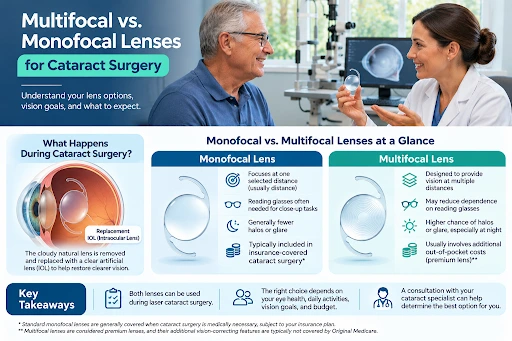
| Feature | Monofocal Lens | Multifocal Lens |
| Reading | Reading glasses are commonly needed when the lens is set for distance vision. | May reduce dependence on reading glasses, depending on lens design. |
| Computer work | Intermediate-distance glasses may be needed when the lens is set for distance vision. | Some designs support intermediate vision, although glasses may still be needed. |
| Night driving | Generally associated with fewer lens-related halos and less glare than multifocal designs. | May cause halos, glare, or reduced contrast sensitivity, especially in low-light conditions. |
| Typical out-of-pocket costs | Standard lens generally included in medically necessary cataract surgery coverage, subject to deductibles and coinsurance. | Usually higher because patients may pay additional charges for presbyopia-correcting functionality and associated noncovered services. |
Table of Contents
Understanding Lens Options for Cataract Surgery
A cataract develops when the eye’s natural lens becomes cloudy, making everyday activities such as reading and driving more difficult.
During cataract surgery, an ophthalmologist removes the cloudy natural lens and replaces it with a clear artificial intraocular lens (IOL). This replacement lens helps focus light onto the retina.
According to the National Eye Institute, surgery is the only way to remove a cataract.
The type of IOL selected influences which distances you may see clearly without glasses.
What Is a Monofocal Lens?
A monofocal lens is an intraocular lens designed to provide its clearest focus at one selected distance.
Most patients choose monofocal lenses targeted for distance vision. This may help with activities such as driving, watching television, and enjoying outdoor scenery. However, reading glasses are commonly needed for close-up activities.
A monofocal lens can also be targeted for near vision if that better matches a patient’s preferences.
Potential advantages include:
- Clear vision at the selected focal distance, depending on eye health and surgical outcome.
- A lower likelihood of certain optical effects, such as halos, compared with multifocal IOLs.
- A familiar option for patients comfortable using glasses.
- Standard monofocal lenses are generally included in covered cataract surgery when medical necessity and other coverage requirements are met.
Important consideration: Monofocal lenses do not provide the same range of focus as multifocal lenses. Additional glasses may be necessary for reading, computer work, or distance activities, depending on the chosen focus.
What Is a Multifocal Lens for Cataract Surgery?
A multifocal lens for cataract surgery is designed with multiple focusing zones to support vision at different distances.
Unlike monofocal lenses, multifocal IOLs distribute light among different focal points. Depending on the design, they may provide useful vision for reading, computer work, and seeing objects farther away.
These lenses are often considered by patients who want to reduce their dependence on glasses.
Potential advantages include:
- Vision designed to function at multiple distances.
- Reduced dependence on reading glasses for some patients.
- Greater convenience when switching between near and distant activities.
- A potential option for patients with healthy eyes who value a wider range of uncorrected vision.
Important consideration: Multifocal lenses can produce halos, glare, or reduced contrast sensitivity, particularly in low-light conditions. Some patients adapt to these effects, while others may continue to notice them.
The American Academy of Ophthalmology explains that presbyopia-correcting lenses can reduce dependence on glasses, although results vary according to lens design and individual circumstances.
Cost Comparison: Monofocal vs. Multifocal Lenses for Cataract Surgery
The main cost difference between monofocal and multifocal lenses is the additional charge for the premium vision-correcting features of a multifocal IOL.
Original Medicare generally covers a conventional intraocular lens and the standard physician and facility services associated with medically necessary cataract surgery when coverage requirements are met. Patients remain responsible for applicable deductibles, coinsurance, and any noncovered services.
When a patient chooses a multifocal or another presbyopia-correcting IOL, Original Medicare continues to cover the eligible conventional cataract surgery components. However, the patient may pay additional charges attributable to the lens’s upgraded presbyopia-correcting functionality and associated noncovered services.
These charges can include the additional lens-related cost beyond a conventional IOL and certain additional fitting or vision-testing services related to the premium functionality.
The Centers for Medicare & Medicaid Services (CMS) distinguishes conventional IOL coverage from noncovered presbyopia-correcting functionality.
How Much Do Monofocal Lenses Cost?
Standard monofocal lenses are generally included in Medicare-covered cataract surgery when medically necessary.
Patient expenses vary depending on insurance coverage, the surgical facility, and applicable deductibles or coinsurance. Your care team can help clarify your benefits before surgery.
How Much Do Multifocal Lenses Cost?
Multifocal lenses typically involve additional out-of-pocket expenses because their presbyopia-correcting features are not fully covered by Medicare.
Expenses depend on the lens selected, surgical facility, additional testing, and related professional services.
Medicare generally covers medically necessary cataract removal and a conventional lens, while patients pay separately for qualifying premium features.
What About Laser Cataract Surgery Fees?
Laser-assisted cataract surgery may involve additional expenses when patients choose eligible elective vision-correction services. However, the laser technique itself does not automatically justify an additional charge under Original Medicare.
Any additional expenses depend on the qualifying elective services selected and the patient’s insurance coverage.
Under Centers for Medicare & Medicaid Services (CMS) guidance, providers cannot separately charge Original Medicare patients for routine covered cataract surgery steps simply because a laser is used.
Additional patient charges must relate to qualifying noncovered services, such as the refractive functionality of a presbyopia-correcting or astigmatism-correcting lens and associated noncovered testing or fitting.
At Lake Eye Associates, patients can discuss lens options, insurance benefits, and potential out-of-pocket expenses before surgery. Your care team can explain which services are covered and which may require additional payment.
How Can You Compare Your Expected Costs?
Before choosing a lens, ask your cataract care team for an itemized estimate per eye. The estimate should clearly identify:
- The conventional cataract surgery services covered by your insurance.
- Your estimated deductible, coinsurance, and copayments.
- Additional charges associated with premium lens functionality.
- Any related elective testing or refractive services.
- Any elective laser-related fees, identified separately where applicable and permitted under your coverage.
- The expected total out-of-pocket amount for each eye.
This breakdown can help you understand what you are paying for and make an informed decision.
Pro Tip: Request written estimates for both monofocal and multifocal lens options before surgery. Comparing the itemized costs alongside your vision goals can help you choose an option that aligns with your needs and budget.
How to Choose Between Multifocal and Monofocal Lenses
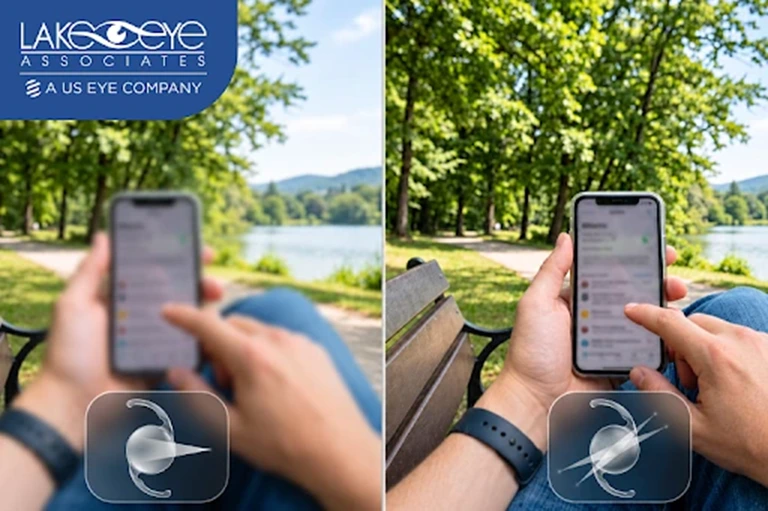
Your decision should begin with understanding how you use your vision and what matters most in your everyday life.
1. Consider Your Daily Activities
Think about the activities you enjoy most.
Do you spend considerable time reading, sewing, gardening, golfing, or using a computer?
If you are comfortable wearing reading glasses, a distance-focused monofocal lens may suit your preferences.
If reducing your reliance on glasses is especially important, a multifocal lens may be worth discussing with your surgeon.
Neither option guarantees complete freedom from glasses.
2. Think About Night Driving
Nighttime vision deserves special attention when choosing an IOL.
Some patients with multifocal lenses notice halos around headlights, glare, or changes in contrast sensitivity. These effects may become less noticeable with adaptation, but experiences vary.
Patients who frequently drive at night should discuss the optical characteristics of different lens designs with their surgeon.
The American Academy of Ophthalmology identifies night driving as an important consideration when choosing an IOL.
3. Evaluate Your Overall Eye Health
Your eye health influences which lens options may be appropriate.
Before recommending a lens, your cataract specialist will evaluate factors such as:
- Corneal health and astigmatism.
- Retinal and macular health.
- Glaucoma or other eye conditions.
- Existing prescription and visual needs.
- Previous eye surgery.
Some conditions affecting the retina, cornea, or optic nerve may limit the suitability of multifocal IOLs.
This is why an individualized examination matters more than choosing a lens based on its features alone.
4. Consider Your Budget and Insurance Benefits
Lens selection is also a financial decision.
Standard monofocal lenses generally involve fewer additional lens-related charges, while multifocal lenses typically require payment for noncovered premium functionality.
Discuss your insurance benefits and expected out-of-pocket expenses with your care team before selecting an IOL.
Can Both Lens Types Be Used With Laser Cataract Surgery?
Yes. Both monofocal and multifocal IOLs can be used during laser-assisted or conventional cataract surgery.
The surgical technique and replacement lens are separate decisions.
In laser cataract surgery, a femtosecond laser assists the ophthalmologist with certain steps, such as creating corneal incisions, opening the lens capsule, or preparing the cloudy lens for removal.
After removing the cataract, the surgeon implants the selected IOL.
Laser-assisted surgery does not automatically require a multifocal or other premium lens.
Both conventional and laser-assisted approaches are established procedures. Your surgeon can explain which surgical approach is appropriate for your eyes.
Patients exploring cataract eye surgery at Lake Eye Associates can discuss their surgical treatment and available lens options during a personalized evaluation.
Quick Fact
Monofocal IOLs can be selected to focus at near, intermediate, or far distances. Distance focus is the most common choice, but the appropriate target depends on individual visual goals.
Are There Other Cataract Surgery Lens Options?
While monofocal and multifocal lenses are common choices, other intraocular lenses may be appropriate for certain patients.
These include:
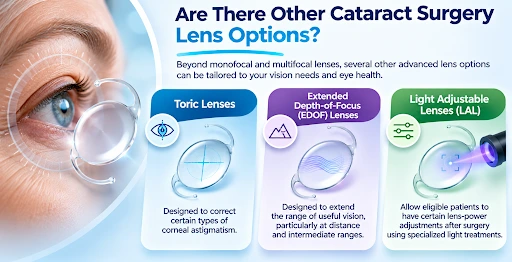
- Toric lenses: Designed to correct certain types of corneal astigmatism. Toric correction is available in different IOL designs.
- Extended Depth-of-Focus (EDOF) lenses: Designed to extend the range of useful vision, particularly at distance and intermediate ranges.
- Light Adjustable Lenses (LAL): Allow eligible patients to have certain lens-power adjustments after surgery using specialized light treatments.
Lake Eye Associates offers a range of lens technologies, including the RxSight Light Adjustable Lens.
For a closer look at another available option, read our article on the Light Adjustable Lens vs. multifocal lenses.
Did You Know?
Some patients can use monofocal lenses in a configuration called monovision. One eye is targeted for distance, while the other is targeted for near or intermediate vision.
This arrangement may reduce dependence on glasses for some activities, but not everyone finds it comfortable.
Your ophthalmologist may suggest a contact lens trial before surgery to help assess whether monovision could suit you.
What Should You Ask Your Cataract Specialist Before Choosing a Lens?
A comprehensive cataract consultation helps your ophthalmologist evaluate your eyes and explain your available options.
Depending on your individual needs, the evaluation may include measurements of your cornea, eye length, astigmatism, and retinal health.
Before making a decision, consider asking:
- Which lens options are appropriate for my eye health?
- What vision can I realistically expect without glasses?
- How might each lens affect reading, computer use, and night driving?
- Are there specific reasons to avoid a multifocal lens in my case?
- What are the expected costs for each eye, including any noncovered premium services?
You can also discuss how you might adapt to your new vision and what follow-up care involves.
If reading glasses are an important concern, our related article, Do I Need Reading Glasses After Cataract Surgery?, provides additional information.
Key Takeaways
- Monofocal lenses provide one selected focal distance and may require glasses for other activities.
- Multifocal lenses are designed to provide vision at multiple distances and may reduce dependence on glasses.
- Multifocal lenses may cause halos, glare, or reduced contrast sensitivity, particularly in low-light conditions.
- Original Medicare generally covers conventional IOLs and eligible standard cataract surgery services, while additional presbyopia-correcting functionality is not covered.
- Patients should request an itemized cost estimate per eye before choosing a lens.
- Both lens types can be implanted during laser-assisted or conventional cataract surgery.
- Eye health, lifestyle, and visual goals are important when selecting an IOL.
Make Your Lens Choice With Confidence at Lake Eye Associates
Choosing between multifocal and monofocal lenses is an important part of preparing for cataract surgery. A monofocal lens may suit patients who prefer clear vision at one selected distance and are comfortable wearing glasses, while a multifocal lens may appeal to those looking to reduce their dependence on glasses for everyday activities.
Your eye health, lifestyle, vision goals, and budget all play a role in this decision. Understanding insurance coverage and potential out-of-pocket costs can also help you plan for surgery with confidence.
At Lake Eye Associates, our experienced ophthalmologists provide personalized cataract evaluations to help patients explore lens options suited to their individual needs. We proudly serve patients across Central Florida, including The Villages, Lady Lake, Leesburg, Tavares, and Wildwood.
Ready to explore your options? Schedule a cataract consultation with Lake Eye Associates to discuss your vision goals, available lens technologies, and treatment considerations with our eye care team.
Medical Disclaimer: The information provided in this blog about multifocal and monofocal lenses is intended for general informational purposes only. It is not a substitute for professional medical advice, diagnosis, or treatment. Always consult your ophthalmologist or another qualified healthcare professional regarding your individual eye health and treatment options.
Frequently Asked Questions
1. How long do cataract lens implants last?
Intraocular lenses are designed to remain in the eye permanently and typically do not require routine replacement.
2. Can dry eyes affect cataract lens measurements?
Yes. Dry eyes can affect the accuracy of measurements used to select an intraocular lens. Your ophthalmologist may recommend treating dry eyes before surgery.
3. How is the power of an artificial lens calculated?
Ophthalmologists measure the eye’s length and corneal curvature, then use specialized formulas to determine an appropriate lens power.
4. Can cataracts return after lens replacement?
Cataracts cannot return once the natural lens is removed. However, the membrane behind the implant can become cloudy, sometimes requiring a laser procedure.
5. Should I stop wearing contact lenses before cataract surgery?
Your ophthalmologist may ask you to stop wearing contact lenses before preoperative measurements because they can temporarily alter the shape of your cornea.


